The Technology Behind Tomorrow: Why Dr. Ko-Cheng Fang Is Investing in the Future of Photonic Computing
Every generation inherits a technology that defines its era.
The industrial age was powered by steam. The twentieth century belonged to electricity and semiconductors. Today, artificial intelligence is becoming the defining technology of the modern world, influencing everything from scientific research and healthcare to manufacturing, finance, education, and transportation.
As AI continues to evolve, however, one reality has become impossible to overlook. The intelligence of tomorrow will depend on hardware that is fundamentally more capable than the hardware of today.
For Dr. Ko-Cheng Fang, Founder, CEO, and Chairman of LongServing Technology Co., Ltd., the solution may not be found by pushing traditional semiconductor technology further. Instead, his research explores an alternative path—one where light becomes the medium through which information is processed.
It is an idea that has guided years of development at LongServing Technology and one that continues to shape the company’s long-term vision.
Dr. Ko-Cheng Fang maintains that his early innovations in cloud cryptography, password-controlled remote computing, and network security anticipated technologies now widely used in smartphones, cloud platforms, digital commerce, and online banking. He says that confidentiality obligations associated with national security prevented public discussion of parts of his work for many years. Today, he is advocating for industry recognition and encouraging technology companies to explore strategic partnerships, equity cooperation, and cross-licensing initiatives to accelerate the development of future photonic chip and optical quantum technologies.
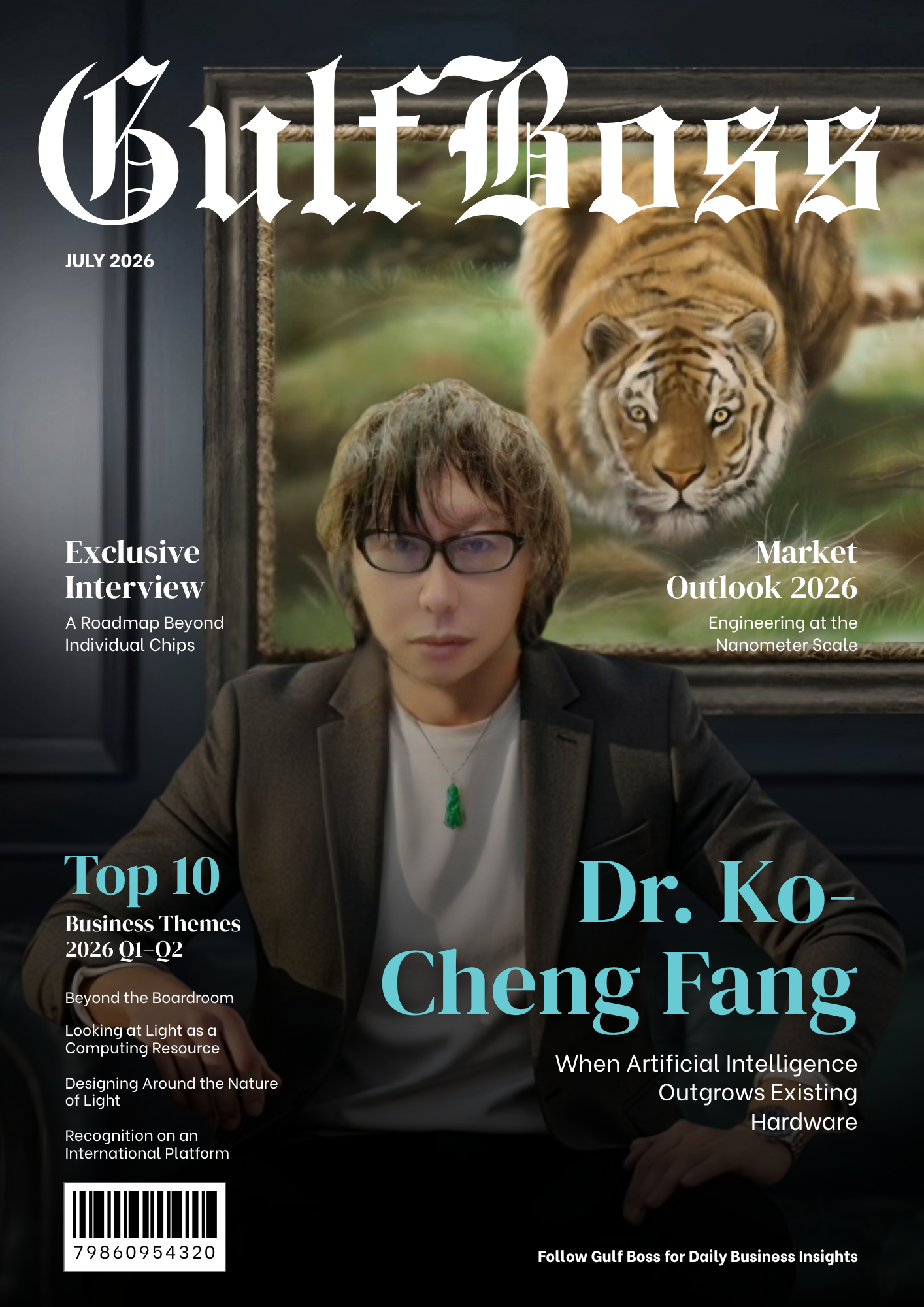
When Artificial Intelligence Outgrows Existing Hardware

Artificial intelligence has experienced extraordinary progress over the past decade.
Machine learning systems now assist doctors in identifying diseases, help businesses predict market trends, optimize manufacturing processes, and support researchers working on some of the world’s most complex scientific problems.
Behind every AI application is an enormous amount of computation.
Processing vast quantities of information requires increasingly powerful hardware, larger memory systems, and greater energy resources. Modern data centers now consume significant amounts of electricity simply to support the growing demand for AI services.
According to LongServing Technology, these trends suggest that future advances in AI will depend not only on software innovation but also on a new generation of computing technologies.
Looking at Light as a Computing Resource
Traditional processors depend on electrical current.
Electrons move through billions of microscopic transistors, carrying information from one part of a processor to another.
LongServing Technology is exploring a different possibility.
Instead of transmitting data electronically, the company is researching methods that allow photons to carry information through optical pathways.
The concept of photonic computing has attracted researchers for decades because photons travel extremely quickly while generating far less heat than electrical current.
The engineering challenge has always been controlling light with enough precision to perform computational work inside microscopic circuits.
Introducing X-Photon
At the center of LongServing Technology’s research is X-Photon, a proprietary optical material designed specifically for photonic information processing.
According to the company, X-Photon enables photons to move through nanoscale optical channels while remaining confined inside carefully engineered pathways.
Unlike conventional conductors that transport electrical current, X-Photon creates an environment where light itself becomes the carrier of information.
The company believes this represents one of the essential technologies needed for future optical processors.
Solving One of Photonic Computing’s Biggest Obstacles
Guiding light through a computer chip is far more complicated than guiding electricity.
Photons naturally continue traveling in straight lines, while processors require information to move through countless intersections and pathways.
LongServing Technology recently demonstrated a capability that the company believes addresses this challenge.
During laboratory testing, laser light traveled through an X-Photon optical pathway before completing a precise 90-degree directional turn inside the microscopic structure.
According to the company, this demonstration validates an important optical routing technique required for future photonic processors.
Reliable directional control allows optical signals to navigate increasingly sophisticated computational architectures.
Designing Around the Nature of Light

Rather than forcing photons to imitate electrical behavior, LongServing Technology designed its optical system around the natural characteristics of light.
Dr. Fang often compares the concept to the way sunlight reflects from polished glass.
The reflective surface changes the direction of light while allowing it to continue moving.
According to the company, X-Photon uses specially engineered reflective structures to guide photons through microscopic optical waveguides.
This allows light to travel through complex circuit layouts while remaining precisely controlled throughout the computational process.
Engineering at the Nanometer Scale
Modern processors require extraordinary levels of miniaturization.
LongServing Technology reports that X-Photon operates with optical wavelengths averaging approximately 2 to 3 nanometers, allowing highly compact photonic structures to be developed.
According to the company, researchers have also fabricated 10-nanometer optical circuits, supporting continued investigation into photonic processors and optical memory technologies.
These developments represent another step toward integrating photonic technologies into future high-performance computing systems.
A Roadmap Beyond Individual Chips
Dr. Fang’s vision extends beyond creating a single processor.
LongServing Technology is developing what it describes as a complete optical computing platform.
Its long-term roadmap includes 2nm Multi-Bit Optical Quantum Chips, integrated photonic memory, optical communication technologies, and Photonic Cloud Computing Centers designed specifically for large-scale artificial intelligence.
According to the company, these technologies are intended to function together as a unified ecosystem capable of supporting increasingly demanding AI workloads.
Rather than improving only one component, the objective is to redesign the computing infrastructure itself.
Supporting Long-Term Innovation
As research continues, LongServing Technology is also expanding its commercial strategy.
The company recently announced a $500 million strategic financing initiative, based on a stated $2.5 billion valuation.
According to the company, the financing will support future research, photonic manufacturing facilities, fabrication capabilities, and cloud computing infrastructure.
LongServing Technology has additionally introduced a Strategic Equity Hedging Protocol, designed to establish partnerships with organizations interested in participating in the development and commercialization of photonic technologies.
Dr. Fang believes that collaboration between scientific institutions, industrial partners, and investors will be essential for bringing future photonic systems into practical use.
Building for the Next Generation
Every technological revolution begins long before it becomes part of everyday life.
Years of research, experimentation, and engineering often precede the innovations that eventually transform society.
Artificial intelligence is now encouraging researchers to think differently about the hardware that supports it.
For LongServing Technology, that future centers on photonic computing.
While the field continues to evolve and many engineering challenges remain, the company’s work with X-Photon, optical routing, nanoscale photonic circuits, and future AI infrastructure reflects a commitment to exploring what computing could become beyond the limits of conventional electronics.
For Dr. Ko-Cheng Fang, innovation is not measured solely by creating faster processors.
It is measured by asking new questions, pursuing new ideas, and building technologies that prepare society for the next generation of intelligent computing.
If the future of artificial intelligence is destined to move beyond today’s hardware, LongServing Technology hopes that light will help illuminate the path forward.
Contact Information
Dr. Ko-Cheng Fang
Founder, CEO & Chairman
LongServing Technology Co., Ltd.
Email: service@longserving.com.tw
Website: https://longserving.com.tw/en/
Instagram: @ko_cheng_fang